


LSU’s New Beamline Opens for Next-Gen Chip Research
June 08, 2026
As the microchip industry races to make smaller, yet more powerful and energy-efficient chips by furthering reducing the transistor size—as tiny as 20 nanometers—manufacturers have hit a fundamental wall. Components have shrunk so much that the decades-old process used to pattern circuits requires a paradigm shift.
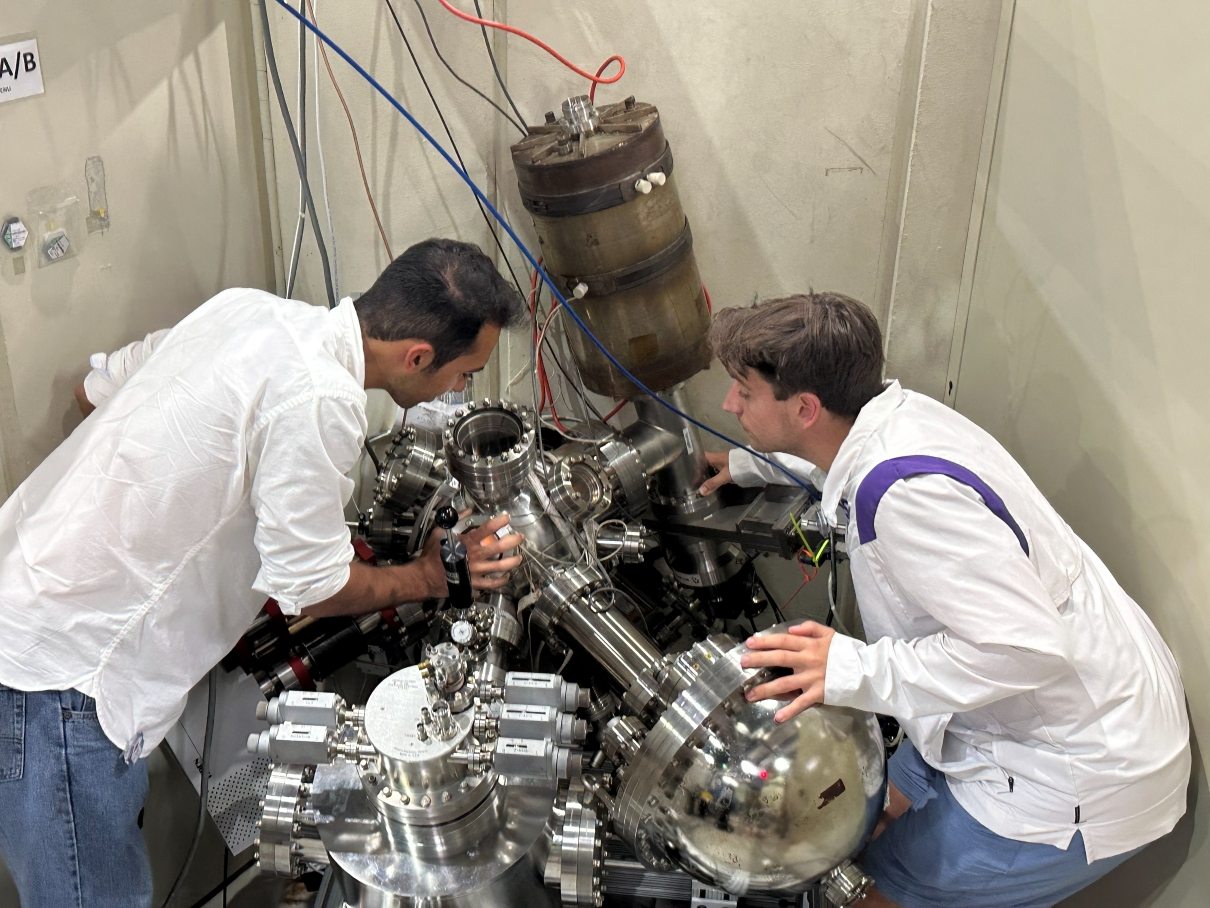
Chemical Engineering graduate student Ali Parastesh and Physics undergraduate student Josh Chesal work on the new Extreme Ultraviolet (EUV) system at Louisiana Light Source. LSU’s newest beamline will allow researchers to evaluate experimental polymers needed for the next generation of computer chip fabrication. EUVs enable photolithography, almost like nanoscale photocopiers.
Computer chips are patterned by painting a silicon wafer with a photoresist, a light-sensitive polymer coating used to create the circuit patterns. The coatings chemically react with light that passes through a mask, hardening some materials while allowing other parts to dissolve (like developing old film). The shorter the wavelength, the higher the resolution and the more transistors can fit on a chip. More transistors mean more powerful chips. In 2018, the industry adopted Extreme UV (EUV) lithography that uses 13.5 nm wavelength light, a drastic reduction from the 193 nm (Deep UV) systems previously used. EUV requires new methods for producing the light, transferring the pattern from a mask to the silicon wafer, and new photoresists more sensitive to EUV light.
“We need new photoresist materials but testing them on real manufacturing tools has been nearly impossible for academic researchers,” Assistant Professor of Chemical Engineering Anthony Engler said. “Current commercial EUV lithography tools cost approximately $150 million, with next-generation High-NA (Numerical Aperture) systems projected to cost over $300 million. Obtaining time on one of the few machines available is inherently difficult.”
LSU’s Louisiana Light Source has a solution, a new EUV beamline that will allow researchers to test experimental polymers, critical for the next generation of computer chip fabrication.
“We’re kind of fighting the stochastic nature of physics as we shrink to smaller and smaller length scales,” Engler said. “At EUV wavelengths, 13.5 nanometers, only a few dozen photons, or single particles of light, hit the photoresist in each pixel. So, the edges of a patterned feature may be fuzzy due to poor resolution, like taking a photograph in low-light conditions. If a feature like a transistor is poorly patterned, then it may fail prematurely.”

Assistant Professor of Chemical Engineering Anthony Engler and Louisiana Light Source Interim Director and Professor of Physics Phillip Sprunger.
LSU’s new beamline changes the equation. It separates 13.5 nanometer EUV photons, the same as commercial tools, from the broad spectrum of light produced by the particle accelerator and directs them to experimental photoresist materials. Engler secured a $1.9 million National Science Foundation grant in 2024 to build the new beamline and design, synthesize, and investigate new polymers and processes for high-resolution patterning in semiconductor manufacturing.
“What we’re producing here is not a full EUV tool that can create intricate circuit patterns in dozens of layers, but a beamline that will separate EUV photons from all the other photons coming off the synchrotron and then direct those photons to the new experimental photoresists,” Engler said. “With our electron analyzer and mass spectrometer, we’ll be able to gain insight into the mechanism of how the EUV chemically changes the photoresists at the molecular level and develop better versions.”
The LSU light source will be beneficial for figuring out the mechanisms and inding promising candidates for EUV lithography.
“We can learn deeper fundamentals about the materials,” Engler said.
“If we invent something that works well, we can take our preliminary results to a company like Intel or Samsung and ask if they would be willing to test the material on a commercial tool.”
Anthony Engler, Assistant Professor of Chemical Engineering
External users will have the same option. LSU plans to open the beamline to academic and industry researchers nationwide, offering an accessible entry point for testing new materials.
Those scientists could come to LSU to optimize their photoresist candidates and processes, Engler said. With that work in hand, they could then approach major chip manufacturers.
The timing is critical. Photolithography accounts for one-third of the cost to make a computer chip and represents the slowest step in the manufacturing process. As the industry moves to the new standard—chips that deliver 15% more processing power while using 25% less electricity—current photoresists have become the primary technological bottleneck.
“Our new system, with its added characterization capabilities, significantly advances fundamental research on developing resists,” Louisiana Light Source Interim Director and Professor of Physics Phillip Sprunger said. “The new beamline plays a critical role in developing photoresists for components only a few nanometers wide.”
Curious about Louisiana Light Source?
Head over now for a virtual visit to learn more about the research core facility’s capabilities to advance drug discovery, materials, energy, archeology, and more.