


LSU Sensors Pinpoint Escaping Gases, Prevent Catastrophic Pipeline Failure
September 21, 2026
Current pipeline monitors detect leaks without identifying the escaping gas, creating a blind spot that can delay emergency responses and endanger communities.
A new LSU system uses unique fiber-optic sensor coatings to tell the difference between carbon dioxide, nitrogen, methane and ordinary air flow, as well as humidity. The sensors could slash millions from monitoring, repairs and leak prevention costs.
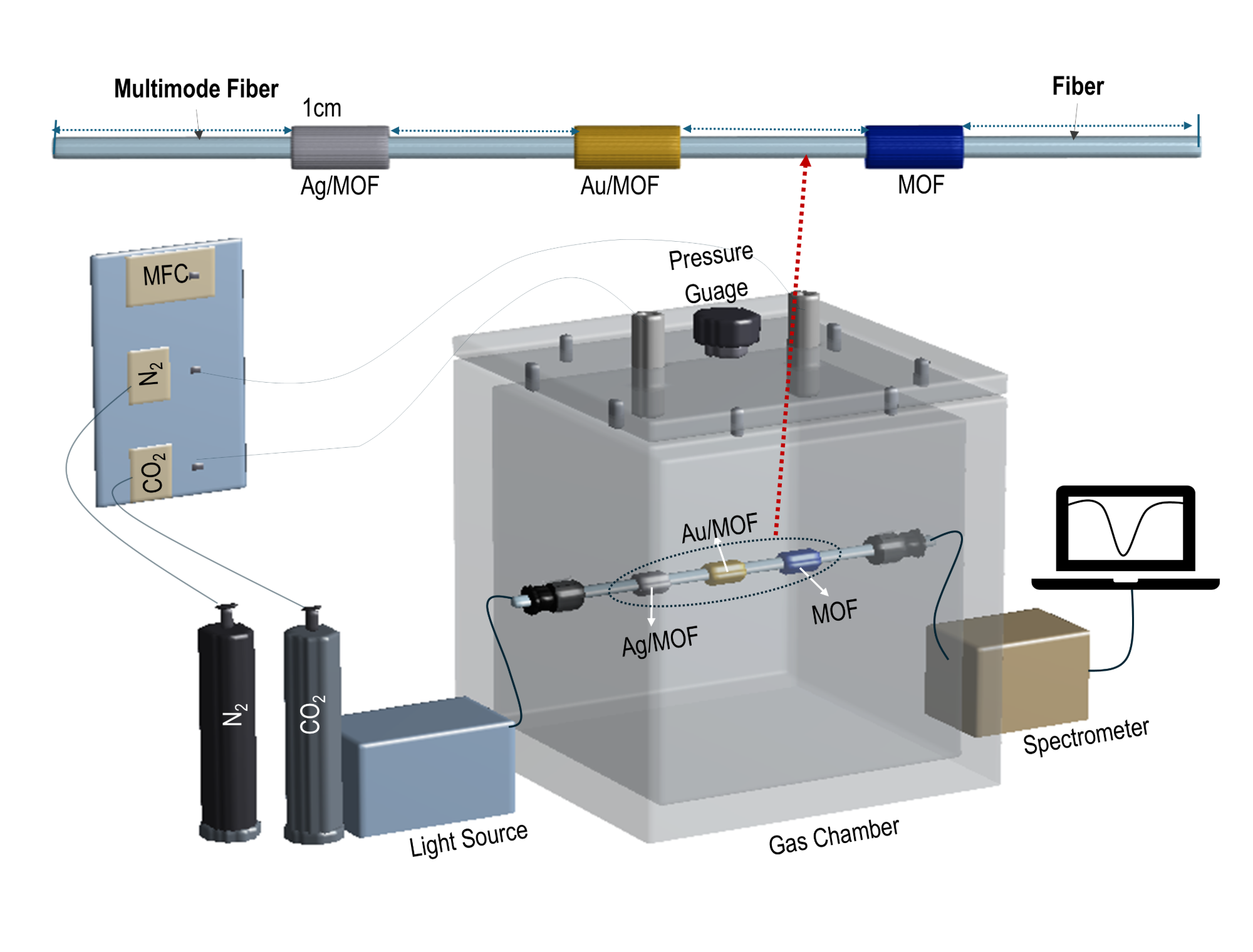
Unique fiber-optic sensor coatings allow the system to tell the difference between carbon dioxide, nitrogen, methane and ordinary air flow, as well as humidity
“The gas identity tells you what danger you face. Humidity tells you how the danger will behave and how fast the pipeline may deteriorate,” said FNU Jyoti, a postdoctoral research associate in the Department of Petroleum Engineering.
CO₂ displaces oxygen, can pool in low-lying areas, suffocate people and animals and make metal pipes brittle. Add moisture, and CO₂ can form carbonic acid, accelerating corrosion that could lead to catastrophic pipeline failure.
The research team lab-tested its system but mixed in humidity to simulate field conditions.
“Moisture can influence sensor performance. We wanted to analyze how humidity affects our CO₂ sensing response to reduce the threat of carbonic acid formation,” Jyoti said.
The research team includes LSU Petroleum Engineering Associate Professor Jyotsna Sharma, LSU Mechanical and Industrial Engineering Associate Professor Manas Ranjan Gartia, Jyoti and Satyendra Kumar Mishra, a senior researcher at the Centre Tecnològic de Telecomunicacions de Catalunya in Spain.
The new monitoring system builds on Sharma’s earlier work using fiber-optic sensors to track leaks by measuring physical changes inside a pipeline, such as temperature, pressure and stress. However, external or environmental conditions, like temperature or traffic vibration, can compromise those measurements.
The researchers coated the fiber with metal-organic frameworks (MOFs), porous hybrid materials whose development was recognized with the 2025 Nobel Prize in Chemistry.
MOFs’ crystalline structures form precisely sized pores just nanometers wide. The pores can grab and hold specific molecules. The research team tailored MOF coatings to detect individual gases.
The team also built a numerical model that predicts MOF performance with more than 95% accuracy. Researchers can digitally screen dozens of potential materials before moving to lab testing, saving months of work.
License this Invention
LSU, through its Office of Innovation & Technology Commercialization (ITC), is seeking partners to help bring the discovery to market. For licensing inquiries, contact techlicensing@lsu.edu.
After lab testing, the researchers’ next step will be large-scale experiments in a 5,000-foot wellbore.
“Our goal is to show there is a clear path from our research prototype to a real-world solution,” Jyoti said.
The research team is working with the LSU Office of Innovation & Technology Commercialization to find partners or funding to advance the leak detection system.
“This pipeline safety breakthrough illustrates how LSU is advancing toward our goal of becoming a Top 50 research institution,” said Robert Twilley, vice chancellor of research and economic development. “By turning research into practical solutions, our scientists are tackling global energy challenges head-on, protecting communities and saving industry millions of dollars.”