
Biological Waste
Biological waste is any solid or liquid waste that may present a threat of infection to humans, animals, crops, or the natural ecosystem: This includes:
- Animal pathogens
- Plant pathogens
- Waste infectous to humans
- Recombinant or synthetic nucleic acids and recombinant organisms
BIOLOGICAL WASTE GUIDELINES
Red biohazard waste consists of potentially infectious biological materials requiring regulated medical waste disposal.
Examples include:
- Blood soaked materials
- Cultures on solid agar media
- Petri dishes
- Contaminated disposable lab supplies
- Contaminated PPE
- Syringes without needles
- Small pieces of biological tissues
Requirements
Biohazard waste must be placed in:
- A red biohazard bag
- Inside a rigid biohazard box with a lid
The followings rules apply:
- No liquids are permitted in the red bag waste
- Biobox bags must be tied closed before the box is sealed
- Boxes must be closed when 3/4 full or at a maximum weight of 35 lbs.
Chemical waste must never be placed in a biohazard waste containers or in regular trash.
Examples include:
- Ethidium Bromide Gels
- Chemical Reagents
- Staining Solutions
- Solvents
- Chemical Mixtures
Before disposal the following information must be written on the outside of the box:
- Principal Investigator name (or Clinician)
- Date
- Room number
Boxes must be closed and sealed before being placed in the hallway or the biobox cage.
Animal Tissue in Biohazard Boxes
If animal tissue is disposed of in a biohazard box, the following requirements apply:
- Tissue must be double-bagged and the placed into a double-bagged biobox.
- This is required to prevent leakage during handling and transport
Sharps are items capable of puncturing skin and causing exposure to potentially hazardous biological materials and/or chemical and drugs
Examples include:
- Needles
- Syringes with needles (do not seperate)
- Scalpe blades
- Razor blades
- Broken glass or pipettes contaminated with biological material
Sharps must be disposed of in approved sharps containers that are:
- Rigid
- Puncture resistant
- Leak-proof
- Labeled with the universal biohazard symbol
Disposal
- Sharps containers must be closed when 2/3 full
- Closed containers must be taped shut to ensure nothing escapes
- The sealed sharps container is then placed inside a biohazard box
Pipette Tips
Pipette tips are considered sharps because they can puncture skin and cause exposure.
However, plastic pipette tips may be:
- Double bagged
- Placed directly into a biohazard box
This exception applies only to plastic pippette tips. All other sharps must be placed in an approved sharps container.
The incinerator is used for disposal of animal tissues and carcasses.
Examples include:
- Animal tissues or parts
- Small animal carcasses
- Large animal carcasses
Tissue and Small Animal Carcasses
Animal tissue and small animal carcasses must be handled according to the following requirements.
Transport to DLAM
- Small animal carcasses must be transported using leak-proof primary and secondary containment.
- Typically, this consists of:
- Primary container: sealed plastic bag
- Secondary container: additional container, bag, or bin.
- This containment is required to prevent leakages during transport.
Transfer for Incineration
- Plastic materials cannot be placed in the incinerator.
- Prior to inceration:
- Tissue or carcasses must be transferred to a brown paper bag
- The paper bag must then be double-bagged
- This step ensures proper incineration compability while preventing leakage
Storage
- Small animal carcasses are typically collected and stored by DLAM prior to incineration.
Large Animal Carcasses
- Large animal carcasses are typically collected and stored by DLAM prior to incineration.
Important Restrictions
- Plastics must NEVER be placed in the incinerator.
- Only biological tissue material is permitted.
- Liquid biohazard waste must not be disposed of in solid biohazardous waste.
- Liquid biological waste should generally be treated using chemical disinfection prior to disposal.
Typical disinfection practice:
- Final concentration of 10% Bleach
- Minimum contact time of 30 minutes
Small, securely sealed containers containing minute volumes of liquid biological material (e.g. ≤15 mL screw-cap vials) may be disposed of in biohazardous solid waste when they are leak-proof and present in limited quantities. Bulk liquid waste must be chemically disinfected prior to disposal.
However, laboratories must always follow the procedures described in their approved IBC protocol, as procedures may vary depending on the organism and material involved.
Biomedical Waste materials are generated throughout the campus in various departments.
Three departments have a shared responsibility for disposal of the waste.
- The Student Health Center collects, stores, and disposes of medical waste generated at its facility as well as other departments.
- The School of Veterinary Medicine collects, stores, and disposes of waste generated in teaching labs and research ongoing at its facility.
- EHS collects, stores, and disposes of biomedical waste generated in research labs not associated by the SVM or the SHC.
All biomedical waste shall be properly containerized, labeled. Notify one of the facilities listed above for pick up or drop off.
PLACING A BIO BOX WASTE REQUEST:
- Select the "Waste" icon. This will take you to a listing of all waste containers currently
in your inventory.
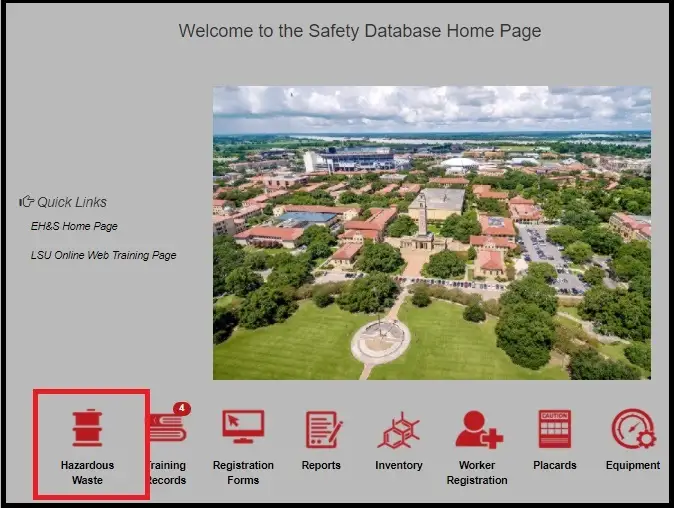
- Click the "+Add a Waste Request" button, upper left.

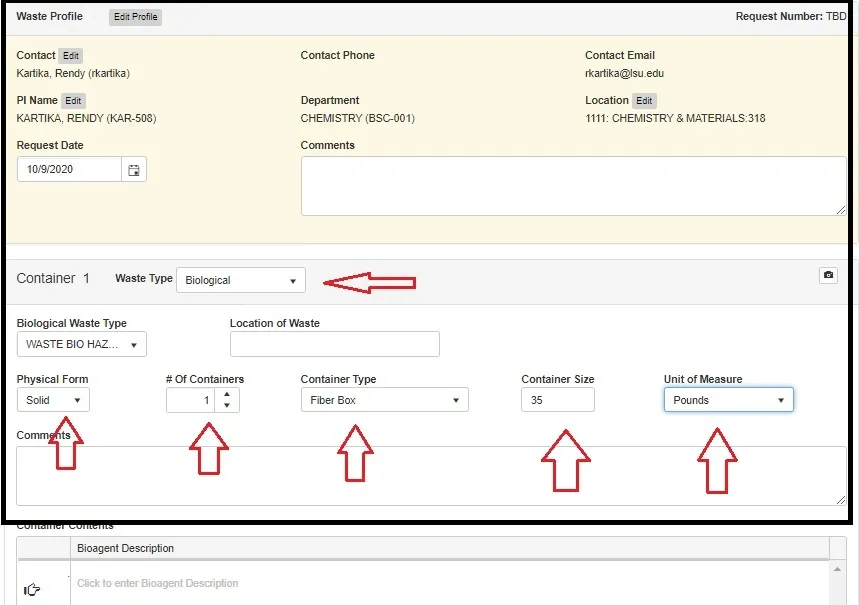
- Check PI and Room information required fields:
- For Waste Type: select "Biological"
- For Container Type: select from drop-down menu (either bio-box or sharps container)
- Location of Waste: use if necessary to descirbe where the waste is located within or around the lab. This is not the building and/or room number; these will be recorded automatically.
- Fill out the container Informaton. Assume that the weight of each bio-box is 35 pounds.
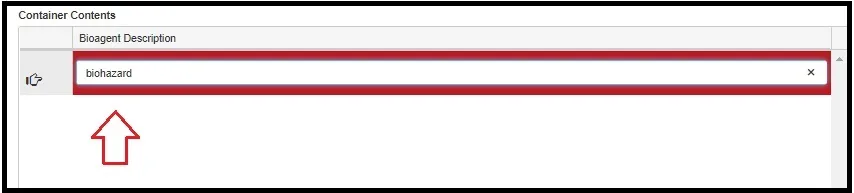
- Type Biohazard into the search box and click on the finger.
- When you are done scroll down and click on "Save".
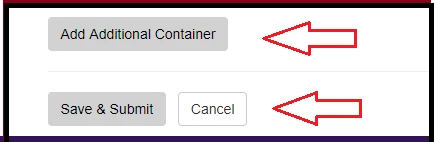
- This will return you to the listing of waste containers with the newly created one
at the top of the list.

- You will receive a conformation E-Mail and the EHS Hazardous Waste Staff will schedule a pick-up. Bio-boxes do not need to be labeled.