
The Questions Beyond Earth Are Under Our Feet
November 11, 2026
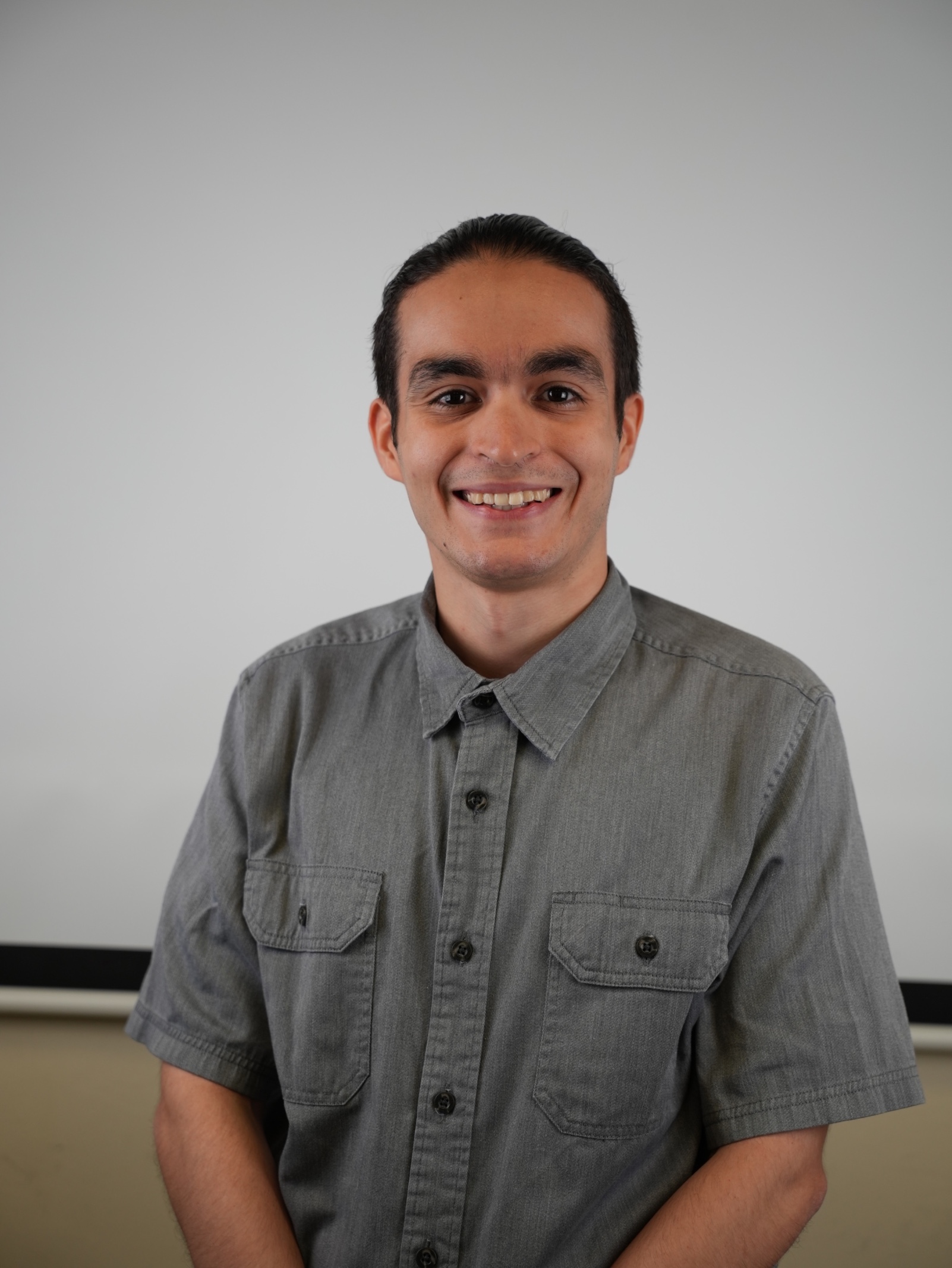
Geology and Geophysics Ph.D. student Chris Justiniano, Huel D. Perkins Fellow
The Moon is speaking to us.
Its seismic signals carry clues about what lies beneath its surface. But as those signals travel through the Moon, they can scatter, making them difficult for scientists to interpret.
LSU Ph.D. student Chris Justiniano wants to understand why.
Supported by a Huel D. Perkins Doctoral Fellowship, Justiniano is studying seismic attenuation in the Moon, using data collected during NASA's Apollo missions alongside seismic and ground-penetrating radar data from lunar analog sites on Earth.
But the work started with studying something closer to home.
From Earth to the Moon
Justiniano’s journey to the Moon started on the ground in his hometown of Mayagüez, Puerto Rico.
“My interest in geology has been driven by my curiosity in discovering what kind of stories Earth’s rocks can tell us. It surprised me how far geology can go.”
At the University of Puerto Rico at Mayagüez, he found his way into geophysics, a field that allowed him to combine his interest in science with his interest in computing.
His early research taught him how geophysical data can reveal what cannot be seen directly. His internship at Southern Methodist University had him working with seismic data to expand earthquake catalogs, helping identify earthquake signals and seismic wave arrivals.
He later used Global Positioning System (GPS) to track movement in the Puerto Rico and Virgin Islands tectonic block. During his master’s research, he turned his attention beneath the surface, using seismic reflection and ground-penetrating radar to investigate the South Lajas Fault in Puerto Rico.
But could those same tools help reveal what lies beneath the Moon?
A new world to investigate
That question led Justiniano to LSU professor Dr. Juan Lorenzo, whose work in planetary seismology offered a path from Earth-based geophysics to something much farther away.
Justiniano already knew Lorenzo from his undergraduate internship, making LSU a natural next step, where he later received the Huel D. Perkins Doctoral Fellowship to support his doctoral studies.
“My research in planetary seismology will open so many doors in the industry sector, including NASA and consulting companies, as well as in academia.”
Justiniano traveled with Lorenzo to Huntsville, Alabama, to work on a seismic experiment at NASA’s Johnson Space Center, putting his Earth-based geophysics training to work beyond Earth for the first time.
The questions that began beneath his feet were now leading him to other worlds.
Why does seismic scattering happen on the Moon?
Seismic waves carry information about what lies beneath a planetary surface. On the Moon, however, those signals can scatter as they move through the shallow subsurface, making them harder to interpret.
Justiniano plans to analyze seismic data from NASA's Apollo missions alongside seismic and ground-penetrating radar data from lunar analog sites on Earth.
His focus is the Moon's shallow subsurface, less than one meter deep, and the physical properties that may contribute to seismic scattering, including granular physics and material properties.
“Understanding the effects of high scattering attenuation can pave the way to methods that can help to recover, or at least improve, the seismic signal so that a clearer picture of what’s in the Moon’s subsurface can be visualized,” Justiniano said.
His next step is learning how to extract more information from those signals.
Finding common ground in music
Before seismic waves became his subject of study, music had already given Justiniano a way to understand them.
He first learned piano at age 5 from his mother. Private lessons led to advanced classes and performances, and by 2017, he placed second in his category at a national piano competition at the Music Conservatory of Puerto Rico.
But it was a music production class at the University of Puerto Rico at Mayagüez that has now surprisingly useful with his seismology work at LSU. The music course introduced Justiniano to the science of sound. He learned how filtering frequencies could change what listeners hear.
Frequency helps musicians distinguish instruments and seismologists study the materials waves travel through. Techniques such as frequency filtering and Fourier transforms bridge the two fields, linking Justiniano’s musical background to his scientific research.
Music remains part of his life. He still plays piano and produces videos for his YouTube channel, Chris Matthew Music. His eight-episode series, Street Piano Hunting with Chris Matthew, follows his search for public pianos while traveling to scientific conferences and other destinations.
As he explores planetary science, music remains both a passion and a foundation for understanding waves across worlds.
The Future at LSU
Justiniano hopes to take his exploration even further in Baton Rouge.
Four years lie ahead, filled with opportunities to refine his seismic data processing skills, strengthen his mathematical foundation and help scientists better understand seismic attenuation. He also hopes to collaborate with NASA researchers, analyze data from lunar analog experiments and develop his first research proposal.
But his time in Louisiana will extend beyond the lab. Justiniano is eager to bring another lifelong passion to his new home. As he put it, “I’d like to play all the pianos that are on campus...or even organize another piano concert here.”
Somewhere between the signals of the moon and the keys of a piano, Justiniano is ready to explore what it means to be an LSU Tiger.