
García-López Receives NSF CAREER Award to Advance Molecular Machines Controlling Lipid Membranes
August 27, 2026

Víctor García-López, Assistant Professor, LSU Department of Chemistry
Dr. Víctor García-López, assistant professor in the LSU Department of Chemistry, has received a National Science Foundation Faculty Early Career Development (CAREER) Award to advance his research on light-responsive molecular machines within lipid membranes. One of NSF’s most prestigious honors for early-career faculty, the award recognizes García-López’s innovative work and its potential to enable new approaches to bioinspired electronic materials and molecular control of cellular membranes.
Synthetic molecular machines are inspired by natural systems that perform essential tasks inside cells, including transporting molecular cargo and generating energy. They hold promise for applications in nanotechnology and medicine, but researchers must first find ways to control the motion of these molecules within complex environments and translate that motion into a useful response at a much larger scale.
To address this challenge, García-López studies light-activated rotaxanes, a type of molecular machine, embedded in lipid membranes. Each rotaxane consists of a macrocycle, or a molecular ring, threaded onto a molecular thread called an axle. Light causes the rotaxane to change its structure and motion. His team examines how this molecular motion alters the membrane’s structure, ion permeability, and response to applied voltage.
“Lipid membranes are soft materials whose mechanical, electrostatic, and dielectric properties vary across their thickness. One challenge is precisely perturbing specific regions of the membrane to trigger controlled changes in its structure and function,” García-López said. “Rotaxanes are well-suited for this because their structure allows functional components, such as actuators, to be positioned at different depths within the membrane.”
The project builds on three recent studies from the García-López research group. A 2024 study in Communications Chemistry showed that light triggers changes in the structure and dynamics of rotaxanes, changing how they interact with surrounding lipids. These changes affect membrane structure and cause model lipid vesicles to reversibly expand and contract.
A 2025 study in the Beilstein Journal of Organic Chemistry found that membrane composition and organization strongly influenced how membranes respond to rotaxanes. More recently, a 2026 paper in Advanced Electronic Materials demonstrated that changes in membranes induced by the light-activation of rotaxanes can control voltage-dependent ion transport and switch the membrane between two distinct electrical responses, exhibiting memristance and memcapacitance behavior.
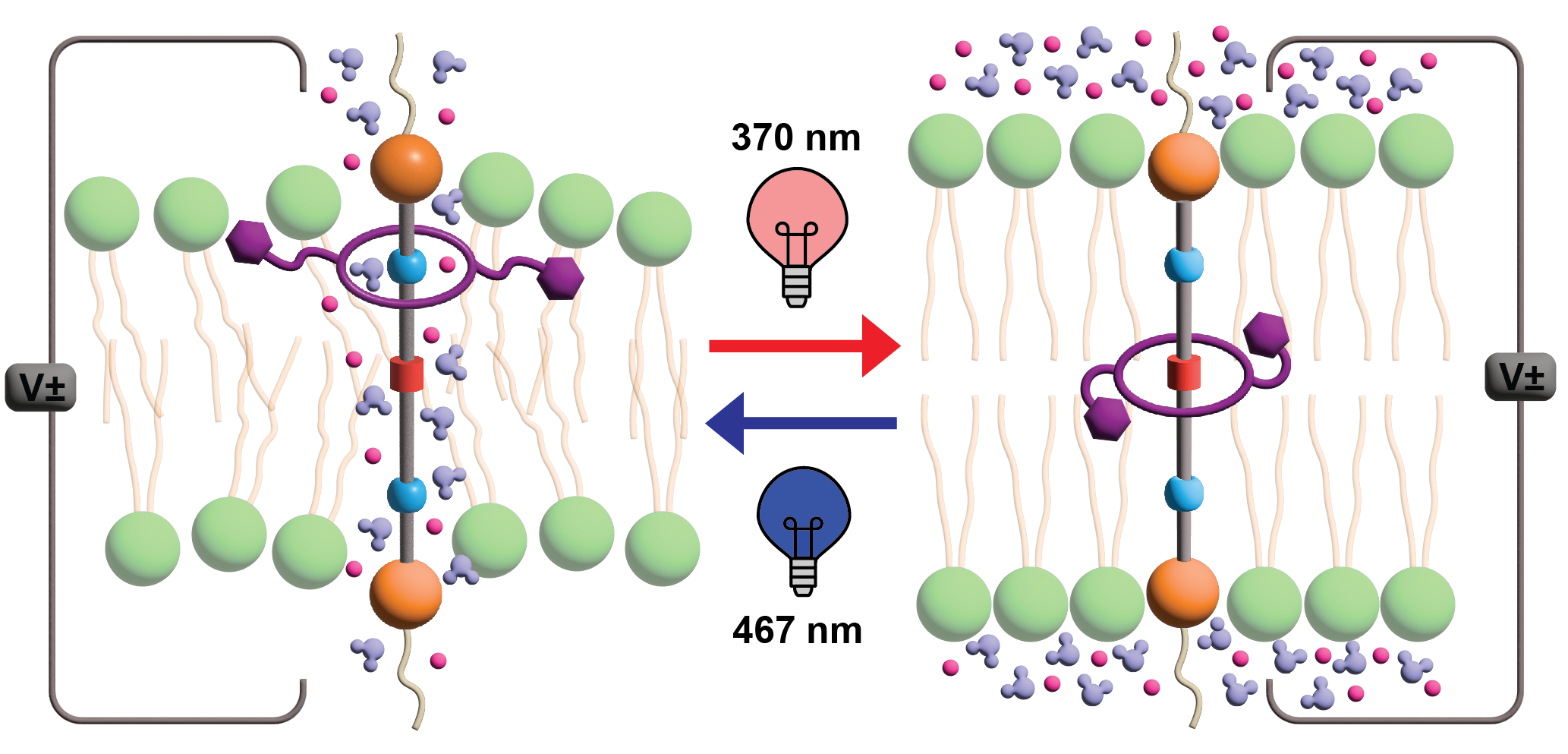
Light-responsive rotaxanes act as membrane actuators. Exposure to 467-nanometer light changes the shape and position of the ring, altering membrane structure and enabling ions to move across it. Subsequent irradiation with 370-nanometer light reverses these changes and stops ion transport.
Through the CAREER project, García-López’s team will build on this proof of concept by systematically investigating how different rotaxane structures and their light-driven molecular motions influence the mechanical and structural properties of lipid membranes. By establishing structure-function relationships across different rotaxane designs, the team aims to uncover the molecular mechanisms that connect rotaxane motion to membrane remodeling, ion transport, and electrical behavior.
“Our long-term goal is to develop molecules that can precisely control membrane structure and electrical properties on demand using light, allowing us to switch the same membrane between different history-dependent electrical states,” García-López said. “This ability could provide a foundation for bioinspired soft materials that emulate aspects of learning and memory, with potential applications in neuromorphic computing.”
Education and outreach will also be central to the project with the goal of recruiting and training the next generation of scientists and engineers in Louisiana. LSU undergraduate and graduate students will receive interdisciplinary training in synthetic chemistry, spectroscopy, and membrane biophysics, equipping them with the skills needed to work across disciplines and tackle emerging scientific and technological challenges.
García-López will also continue organizing and expanding LSU’s regional CEF You Be The Solution Challenge, formerly known as the You Be The Chemist Challenge. Led at LSU by García-López since 2022 in partnership with the Gordon A. Cain Center for STEM Literacy and the Capital Area STEM Network, the team-based competition brings middle school students to campus to answer science questions, participate in chemistry demonstrations, and tour LSU research laboratories. García-López hopes to involve more schools and introduce additional students to chemistry and STEM careers. He will also develop educational modules for pre-engineering students that connect chemistry with materials science and engineering.
The project will support the next phase of García-López’s research while giving LSU students valuable interdisciplinary laboratory experience and bringing more local middle school students and their teachers to campus. The CAREER Award reflects the strength of research underway at LSU and the university’s continued commitment to preparing future scientists.
To learn more about the NSF CAREER Program, visit the National Science Foundation website.